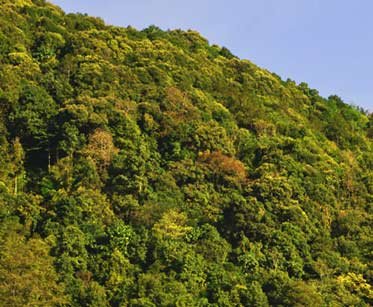
At the Terrestrial Ecology Lab, we conduct ecological research across various scales, including population, community, and landscape levels, spanning a diverse array of ecosystems.
Our focus lies in understanding how species diversity is organized and sustained across different spatial scales, primarily concentrating on plant diversity. We investigate various aspects such as species distributions, plant life histories, invasions, environmental variations, spatial structure, demographic processes, dispersal, and succession. Of particular interest is the functional trait variation and adaptive capacity within and among populations of widely distributed and important tree species to emerging temperature and drought stress due to climatic changes.
While such research is of fundamental importance to ecology, we believe it is highly relevant for responding to current challenges in conservation and sustainable development in the face of habitat degradation and loss, and global environmental change. It can help design/manage biodiversity conservation, afforestation and restoration programmes, wildlife habitat management, production forestry, carbon sequestration, forest-dependent livelihoods, agroforestry-based production and conservation, watershed management, and various land management interventions.


In this project we focus on evaluating the potential for achieving GIM objectives in the state of Madhya Pradesh. The broader objectives of GIM at the national level are (i) increasing tree cover or forest cover in forest and non-forest lands, (ii) improving ecosystem services including biodiversity, carbon sequestration, and hydrological services, and (iii) increasing forest-based livelihoods for millions of households.
Climate change-driven heat stress and drought stress will impact tropical ecosystems if tree species cannot cope through adaptation or range shifts. Forest restoration through active tree planting can mitigate climate change impacts, but plantations would suffer the same consequences due to climate change as natural forests. Restoration plantations should, therefore, be climate-resilient and robust against future environmental changes to ensure the flow of ecosystem services.
Robert John Chandran is Associate Professor of Biological Sciences at the Indian Institute of Science Education and Research Kolkata (IISER Kolkata). Prior to joining IISER Kolkata in 2010, he served as Fellow at Ashoka Trust for Research in Ecology and the Environment, Bangalore.
Robert earned a BSc in Chemistry and Biology at from Bangalore University and MSc and MTech from the Indian Institute of Technology, Delhi. Following that he earned a PhD from the Indian Institute of Science, Bangalore for his work on understanding the determinants of tree diversity in tropical dry deciduous forests of southern India. For several years during his PhD and post-doctoral stints at the University of Georgia, Athens, Smithsonian Tropical Research Institute, and the University of Illinois, Urbana-Champaign, he worked with a global network of tropical forest plots to understand how biotic interactions, resource competition, dispersal, and stochasticity may influence the maintenance of high species diversity in tropical forests.
At IISER Kolkata, he leads a team of researchers on ecological research at the population, community, and landscape scales, in a wide range of ecosystems. Using a combination field ecology, GIS/Remote Sensing based data, and statistical models, we investigate how species diversity is organized and maintained at multiple spatial scales, by studying patterns of plant diversity, species distributions, plant life histories, plant invasions, environmental variation, demographic processes, dispersal, succession, and community structure. Over the years we have worked on grasslands, tropical dry forests, and montane ecosystems in the Terai Duar Savanna and Grasslands, Eastern Himalaya, and central India.
Current areas of research in the lab include investigation of adaptive capacity for thermal and drought stress tolerance in central Indian tree species, drivers of land use landcover changes and vegetation transitions in central India and Terai Duar Savanna and Grasslands, and impacts of land cover changes on biodiversity and carbon cycling in multifunctional landscapes.