Ongoing Projects

Investigating adaptive strategies of forest trees to temperature and water stress to inform climate-resilient forestation in central India
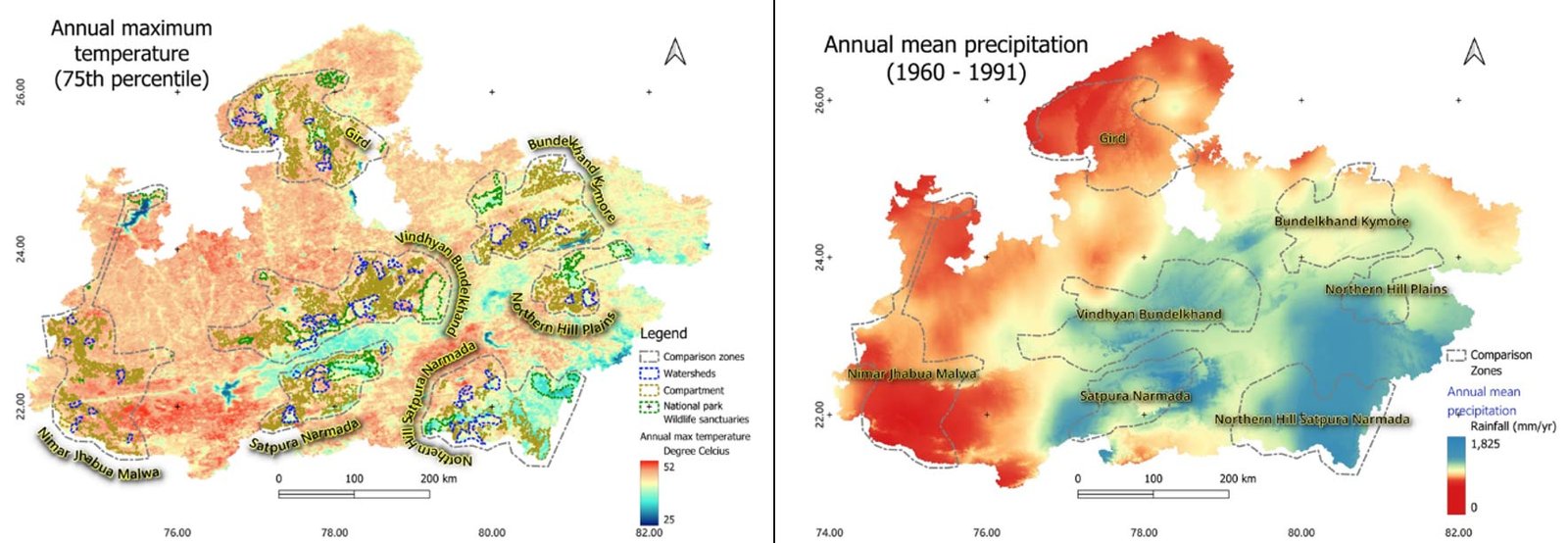
Our study aims to understand the adaptive capacity of central Indian forest tree species by quantifying the variation in plant traits within and among populations and species for about 35 important species that occur naturally across sharp precipitation and temperature gradients.
Climate change-driven heat stress and drought stress will impact tropical ecosystems if tree species cannot cope through adaptation or range shifts. Forest restoration through active tree planting can mitigate climate change impacts, but plantations would suffer the same consequences due to climate change as natural forests. Restoration plantations should, therefore, be climate-resilient and robust against future environmental changes to ensure the flow of ecosystem services. Achieving this demands a detailed understanding of the plasticity and adaptive capacity of tree species to climatic stressors. Heat stress tolerance and drought tolerance, among other performance indicators, would be critical in determining survival, growth, and reproduction.
Our study aims to understand the adaptive capacity of central Indian forest tree species by quantifying the variation in plant traits within and among populations and species for about 35 important species that occur naturally across sharp precipitation and temperature gradients. We will measure the variation in morphological, physiological anatomical, and leaf chemical traits, which either directly or indirectly influence heat stress tolerance and drought tolerance. Using Green Indian Mission interventions as the context, we will focus on quantifying trait-environment linkages for these tree species and develop robust models for generating species assemblages to implement climate-resilient forestation.
Climate change has significant effects on forest tree distributions. As temperatures and rainfall patterns change, trees can only survive by undergoing range shifts or adapting to new conditions. Reforestation programs should select the tree species based on their ability to cope with climatic changes as well as their ecological and economic value. For sustainable and climate-resilient forestation, current tree plantation programs must account for future climate scenarios. Conventional species distribution models usually consider only species presences or abundances and do not account for their phenotypic plasticity and adaptive strategies. Recent analytical approaches have improved upon conventional species distribution modeling by incorporating functional trait variations as a measure of the plasticity and adaptive capacity of tree species These improved models should yield more accurate predictions for future distributions as they account for plant stress tolerance and performance under changing climates. Based on the foregoing arguments we plan to investigate patterns of within- and among-species trait variability in 35 important central Indian tree species in seasonally dry tropical forests.